
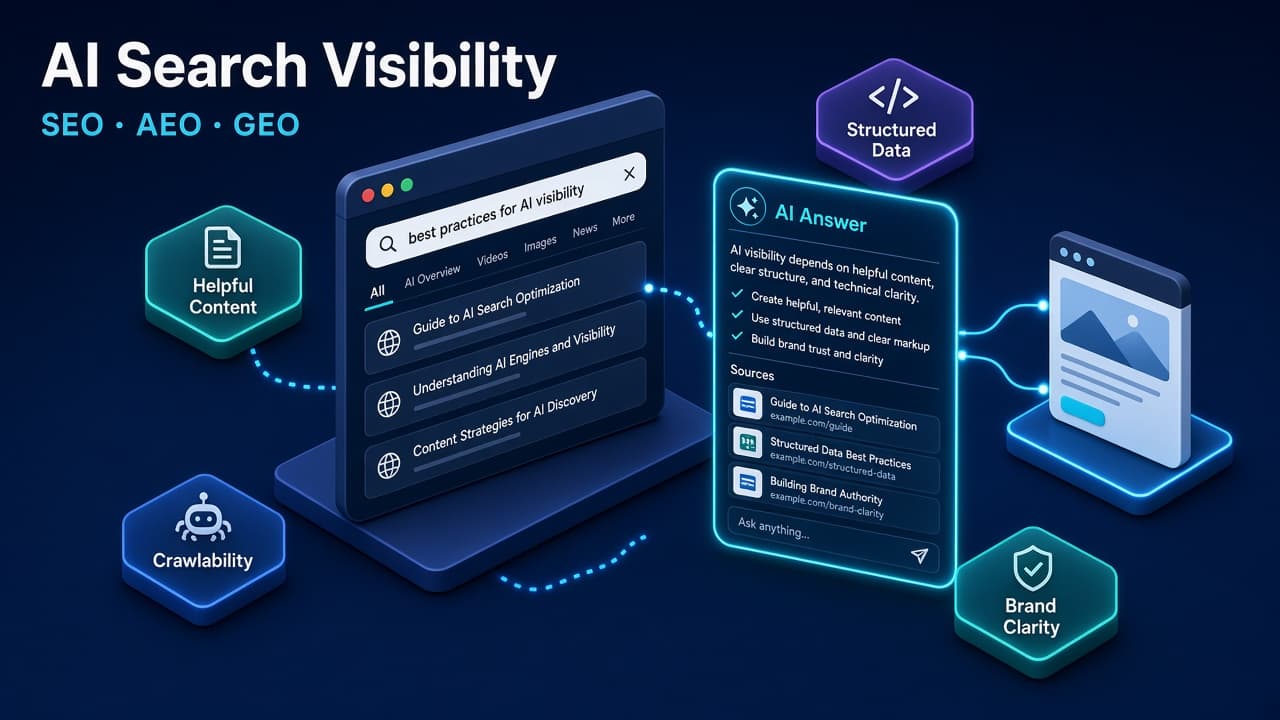
People increasingly use a combination of traditional search engines and AI-powered tools to research products, compare services and discover businesses.
This creates new opportunities for companies that publish useful, accurate and accessible information online. A potential customer might find a business through Google Search, encounter a website link in an AI-generated search response, or ask an AI assistant to explain available service options.
For businesses investing in digital marketing, this has led to growing interest in SEO, Answer Engine Optimization (AEO) and Generative Engine Optimization (GEO). The most useful starting point is to understand how these approaches relate to established SEO practices.
Author: Sai Charan Teja Rayudu, Founder & CEO at WebNextra. Last updated: 13 October 2026.
01
What Is ChatGPT SEO?
The term ChatGPT SEO generally refers to efforts to make a website's content easier to discover, understand and potentially surface in ChatGPT search experiences.
It is not a separate ranking system that website owners can control. Appearance depends on relevance, retrieval, available sources and the way a particular query is handled.
Businesses should focus on publishing reliable information, maintaining accessible pages and ensuring their brand details are consistent.
OpenAI provides official guidance for publishers on crawler access and website discovery. Website owners who want content to be discoverable in ChatGPT Search should review the requirements for OAI-SearchBot and their robots.txt configuration. See OpenAI's crawler documentation for the current details.
02
What Are AEO and GEO?
Answer Engine Optimization (AEO)
AEO refers to structuring information so that it directly answers the questions people ask.
Examples include clear explanations of a service, concise definitions, practical instructions and FAQs that address real customer concerns.
Generative Engine Optimization (GEO)
GEO refers to efforts to improve the likelihood that useful website information can be discovered or referenced in generative AI search experiences.
It often overlaps with traditional SEO: accessible pages, original information, clear structure, credible sources and a well-maintained website.
Neither AEO nor GEO provides a guaranteed way to obtain AI citations or recommendations.
03
How to Improve Your Website for AI-Assisted Search
1. Create original, useful content
Avoid publishing generic articles that simply repeat information available everywhere. Instead, answer specific customer questions and explain practical considerations that help readers make decisions.
For example, a digital marketing agency can publish a guide explaining how it evaluates lead quality, what conversion tracking involves, and how businesses should assess campaign performance. Our guide to generating quality leads through digital marketing is one example of that approach.
If you have genuine project experience, use it to add useful detail. Clearly distinguish actual results from examples or hypothetical scenarios.
2. Answer important questions clearly
Use descriptive headings that accurately explain each section. A service page might answer:
- What does the service include?
- Which businesses may benefit from it?
- What is the process?
- Which factors affect cost?
- How is performance measured?
- What information is needed to begin?
Provide a direct answer before adding supporting detail. This improves readability for people and helps systems interpret the page's subject.
3. Maintain technical accessibility
Important content should be available to search crawlers and not accidentally blocked by robots.txt, authentication requirements or technical errors. Review:
- HTTP response status.
- Indexability and canonical URLs.
- XML sitemap configuration.
- Internal links.
- Mobile usability.
- Page loading performance.
- JavaScript rendering where applicable.
- Robots.txt rules and crawler access.
For ChatGPT Search, review OpenAI's published crawler guidance. For Google AI features, follow Google's existing search technical requirements. A well-built site makes this much easier; our website development work treats crawlability as a launch requirement, not an afterthought.
4. Build a clear brand identity
Use the same business name, website URL and verified contact information across your website and legitimate business profiles.
Create a detailed About page, describe your actual services and identify the people or organization responsible for your content. Where appropriate, publish author information, genuine case studies and clear explanations of your working process.
Do not fabricate reviews, awards, client relationships or expertise.
5. Use structured data appropriately
Structured data can help describe a page and its contents in a standardized format. For example, BlogPosting or Article markup can identify an article's headline, author and publication information. Organization markup may describe a business's identity.
The structured data must accurately reflect visible page content. Adding schema does not guarantee better rankings, an AI Overview citation or a ChatGPT recommendation. There is no special schema type that guarantees inclusion in Google AI Overviews.
6. Develop useful internal links
Link related articles to relevant service pages and supporting guides. For example, a blog about AI search optimization can link to your SEO services page and a technical SEO guide.
Use descriptive anchor text and ensure each link helps readers find relevant information.
7. Earn credible references and mentions
Relevant industry publications, genuine partnerships and reputable websites can help people discover your business and learn about its work.
Focus on useful contributions and authentic relationships rather than purchasing large quantities of irrelevant links or arranging artificial mentions.
04
Google AI Overviews: What Website Owners Should Know
Google's official guidance states that the same foundational SEO practices remain relevant to its AI search features.
Pages need to meet the applicable technical requirements and be eligible to appear in Google Search. Even when a page meets those requirements, inclusion in an AI-generated feature is not guaranteed.
Google also advises website owners to focus on unique, helpful content rather than tactics designed solely to manipulate AI responses. Official resources:
05
How to Measure AI Search Visibility
Use a combination of available evidence rather than relying on a single third-party AI visibility score.
Google Search Console
Monitor search impressions, clicks, queries and page performance. Where available in your Search Console account, review reporting specifically related to generative AI search features.
Website analytics
Look for referral visits from AI platforms where the analytics platform reports them. Review landing pages, engagement and enquiries associated with those visits.
Lead-source tracking
Ask customers how they discovered your business. A short enquiry form question can help distinguish Google Search, ChatGPT, referrals and other sources.
Periodic visibility checks
Review relevant customer questions and branded search results periodically. Record observations carefully, as results may vary by query, time and context.
06
Common AI SEO Mistakes to Avoid
- Assuming that adding an FAQ section guarantees AI citations.
- Publishing large volumes of repetitive AI-generated articles.
- Adding schema that does not match visible content.
- Blocking crawlers unintentionally.
- Creating artificial brand mentions.
- Treating third-party AI visibility estimates as exact traffic measurements.
- Promising clients guaranteed placement in AI Overviews or ChatGPT.
07
How WebNextra Can Help
WebNextra's SEO and digital marketing approach brings together technical website improvements, content planning, search intent research, internal linking and conversion measurement.
For businesses exploring AI search visibility, the priority should be to build a reliable online presence that helps potential customers understand the business and make informed decisions. A sustainable strategy combines useful content with sound technical SEO and measurable business objectives.
If you are also weighing paid search alongside organic visibility, read our comparison of SEO vs Google Ads, or contact WebNextra to discuss your website.
FAQ
Frequently Asked Questions
Can SEO help a website appear in ChatGPT Search?
SEO fundamentals can help make content discoverable and accessible, but appearance in ChatGPT Search depends on multiple factors. No agency can guarantee a citation for every query.
Is GEO different from traditional SEO?
GEO describes efforts aimed at visibility in generative AI experiences. Many practical activities overlap with SEO, including creating useful content, maintaining crawlability and providing clear information.
Is special schema required for Google AI Overviews?
Google's official guidance does not require special AI Overview schema. Use structured data when it accurately describes the page and supports an applicable purpose.
Should I create a separate page for every AI search question?
Not necessarily. Create pages based on meaningful user needs and distinct search intent. Avoid generating many near-identical pages solely to target wording variations.
How long does AI SEO take to show results?
There is no universal timeline. Discovery, crawling, indexing and the appearance of a page in AI-generated responses are not guaranteed and may change over time.
Related reading
- Local SEO in Hyderabad: How Businesses Can Improve Their Local Search Visibility
- How to Choose SEO Services in Miyapur, Hyderabad
- Local SEO for Businesses in Hyderabad
Want this done for your business? See SEO services in Hyderabad.