
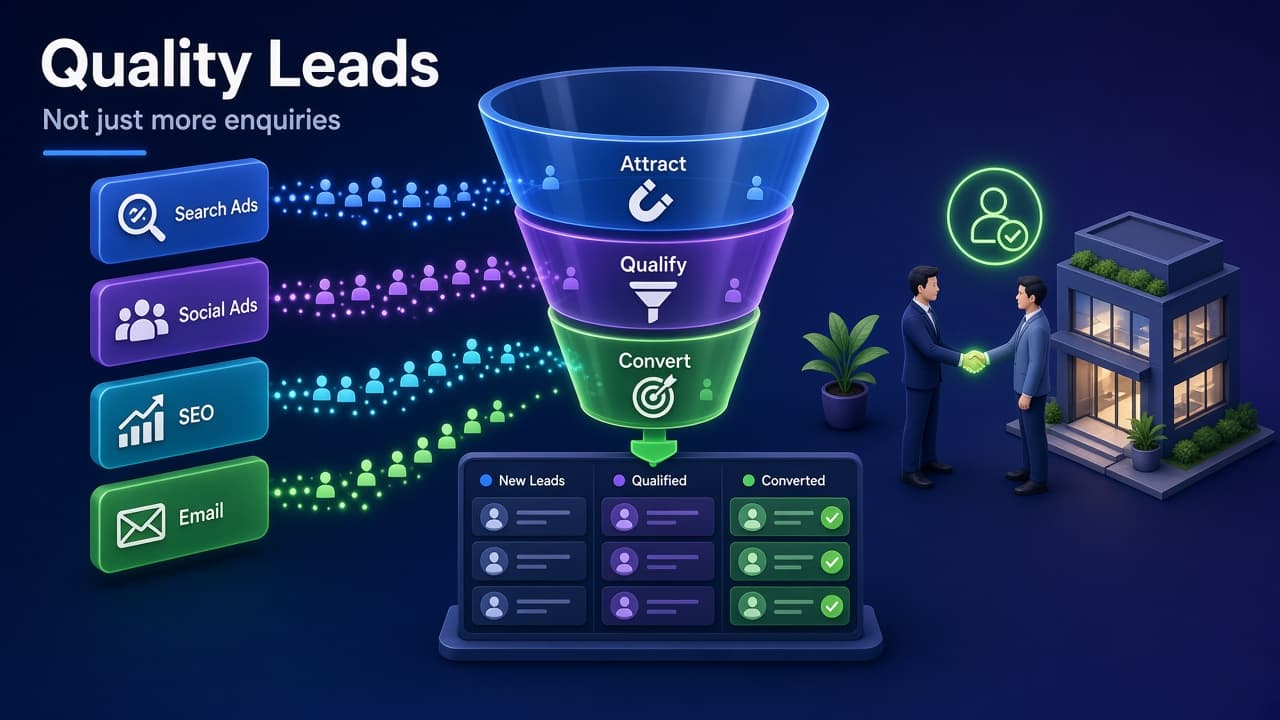
Many businesses invest in digital marketing to attract potential customers. Yet a common challenge remains: receiving enquiries is not the same as generating qualified leads.
A business may receive form submissions from people who are not interested in the service, do not meet the intended customer profile, or are not ready to make a purchase.
A stronger lead generation strategy focuses on attracting relevant prospects, setting clear expectations, tracking meaningful actions and improving the process from first visit to customer conversion. For businesses in Hyderabad and across India, this approach can help make digital marketing decisions more measurable and practical.
Author: Sai Charan Teja Rayudu, Founder & CEO at WebNextra. Last updated: 20 October 2026.
01
What Is Digital Marketing Lead Generation?
Digital marketing lead generation is the process of attracting potential customers through online channels and encouraging them to take a relevant action. These actions may include:
- Submitting a contact form.
- Requesting a consultation.
- Calling a business.
- Booking an appointment.
- Requesting a quote.
- Registering for a relevant event.
A lead becomes qualified when it meets criteria that are meaningful for the business, such as service requirement, location, budget range, decision-making role or purchase timeline.
Qualification criteria should reflect the actual business model and must not unnecessarily collect sensitive personal information.
02
Why Lead Quality Matters More Than Lead Volume Alone
A campaign generating many enquiries may still perform poorly if most enquiries are irrelevant or cannot be converted into customers. Lead quality helps businesses evaluate whether their marketing is reaching the right audience.
For example, a B2B company may prioritize enquiries from businesses that need its service, while a local service provider may focus on customers within its actual service area.
The objective is not to reject leads based on arbitrary assumptions. It is to understand whether the enquiry matches the service being offered.
03
1. Define Your Ideal Customer
Start by identifying the customers your business can serve effectively. Consider:
- The service or product they need.
- Their location and service eligibility.
- Their main problems or goals.
- Their typical decision-making process.
- The information they need before contacting you.
- The factors that determine whether a lead is qualified.
Use customer interviews, existing sales data and genuine enquiry patterns to refine this profile. Avoid making assumptions about customer intent based only on demographic information.
04
2. Choose the Right Marketing Channels
Different channels serve different purposes.
Google Ads
Search advertising can help reach people looking for a specific product or service. Keyword selection and landing page relevance are important for attracting appropriate enquiries. Our guide to Google Ads lead generation in Hyderabad covers campaign setup in detail.
Meta Ads
Facebook and Instagram advertising can introduce offers to relevant audiences and encourage people to enquire. Creative quality, audience selection, form design and follow-up influence the outcome. For a side-by-side view, see Google Ads vs Meta Ads for lead generation.
Search Engine Optimization
SEO can help businesses reach people researching relevant questions and services through organic search. Useful service pages, clear website navigation and informative content support this process. Our SEO vs Google Ads comparison explains how organic and paid search fit together.
Email and Customer Follow-up
Where people have provided appropriate consent, email communication can help businesses share relevant information and continue the conversation.
The right channel mix depends on the target audience, customer journey, budget and sales process.
05
3. Build a Landing Page That Matches the Offer
A landing page should continue the message that attracted the visitor.
For example, someone clicking an advertisement for a specific service should land on a page that explains that service rather than a generic homepage with little relevant detail. An effective landing page generally includes:
- A clear headline.
- A concise explanation of the service.
- Relevant benefits and deliverables.
- Genuine evidence or case studies where available.
- A clear call to action.
- A simple and accessible enquiry form.
- Accurate contact information and privacy details.
Avoid exaggerated claims, fake countdowns and misleading promises. If your site needs this foundation, start with website development built around enquiries.
06
4. Ask Useful Qualification Questions
Forms should collect only the information needed to respond appropriately.
Depending on the service, useful questions might cover the requested service, business location, project requirements or preferred contact method. For high-value B2B services, a company name or project timeline may help a team prepare for a relevant conversation.
Keep forms proportionate. Excessive questions can discourage suitable prospects from completing the enquiry. Explain how the information will be used and follow applicable privacy and consent requirements.
07
5. Track Conversions Correctly
Conversion tracking helps identify which marketing activities contribute to meaningful actions. Possible events include:
- Completed enquiry forms.
- Qualified phone calls.
- Consultation bookings.
- Qualified leads recorded in a CRM.
- Completed purchases or signed contracts.
Test the implementation carefully. Duplicate conversion events or tracking accidental button clicks can distort campaign results.
Where practical, connect lead outcomes back to advertising and analytics systems so that optimization is based on lead quality rather than raw enquiry volume alone.
08
6. Improve the Lead Follow-up Process
Lead generation does not end when a form is submitted.
Businesses should have a clear process for reviewing enquiries, responding within a reasonable timeframe, recording outcomes and arranging the next step.
A CRM or structured lead register can help track whether a lead is new, contacted, qualified, awaiting a response or converted.
Use a consistent process to identify common reasons enquiries do not progress. These findings may reveal problems with targeting, messaging, pricing clarity or sales follow-up.
09
7. Measure the Right Metrics
Useful lead generation metrics include:
- Cost per lead: Total campaign expenditure divided by the number of leads generated, using a clearly defined reporting period.
- Cost per qualified lead: Campaign expenditure divided by the number of leads that meet the agreed qualification criteria.
- Lead-to-customer rate: The proportion of leads that become customers.
- Customer acquisition cost: The relevant marketing and sales costs required to acquire a customer, calculated using a consistent method.
- Return on advertising spend: Revenue attributed to advertising divided by advertising expenditure, where attribution and revenue data are sufficiently reliable.
These metrics answer different questions. A low cost per lead does not automatically mean the campaign is profitable.
10
Common Lead Generation Mistakes
- Focusing exclusively on low-cost leads.
- Using vague advertising messages.
- Sending all visitors to the same landing page.
- Failing to track qualified outcomes.
- Asking for unnecessary personal information.
- Ignoring follow-up and CRM processes.
- Promising results without evidence.
- Changing campaigns before enough useful data is available.
11
How WebNextra Can Help Businesses Improve Lead Generation
A lead generation strategy should connect audience research, campaign planning, website experience, conversion tracking and lead follow-up.
WebNextra supports businesses through digital marketing services, Google Ads management and SEO, and helps establish a clearer framework for measuring marketing performance. The best approach depends on the business's goals, audience, sales cycle and ability to serve incoming enquiries.
Instead of pursuing the highest possible number of leads, focus on attracting relevant prospects and building a process that helps turn genuine interest into customer relationships. Contact WebNextra to review your current lead generation setup.
FAQ
Frequently Asked Questions
What is a quality lead?
A quality lead is a potential customer who matches the business's relevant criteria and has a genuine interest in the service or product being offered.
Which channel is best for lead generation?
Google Ads, Meta Ads, SEO and other channels can all support lead generation. The best choice depends on customer intent, audience, budget and business objectives.
How can I reduce fake or irrelevant leads?
Improve audience and keyword relevance, clarify the offer, use proportionate qualification questions, validate tracking and review actual lead outcomes. No method eliminates every irrelevant enquiry.
How much should a business spend on lead generation?
The appropriate budget depends on customer value, expected conversion rates, competition and the business's financial capacity. Start with measurable objectives and adjust based on evidence.
How do I calculate cost per qualified lead?
Divide the relevant marketing expenditure by the number of leads that meet your defined qualification criteria during the same reporting period.
Related reading
- How a lead generation company in Hyderabad can boost enquiries for small and medium businesses
- How Hyderabad Digital Marketing Agencies Turn Searchers into Callers: Tactics, Costs and KPIs
- Online Lead Generation in Hyderabad: Channels, Costs and a Practical Playbook
Want this done for your business? See Lead generation services in Hyderabad.