

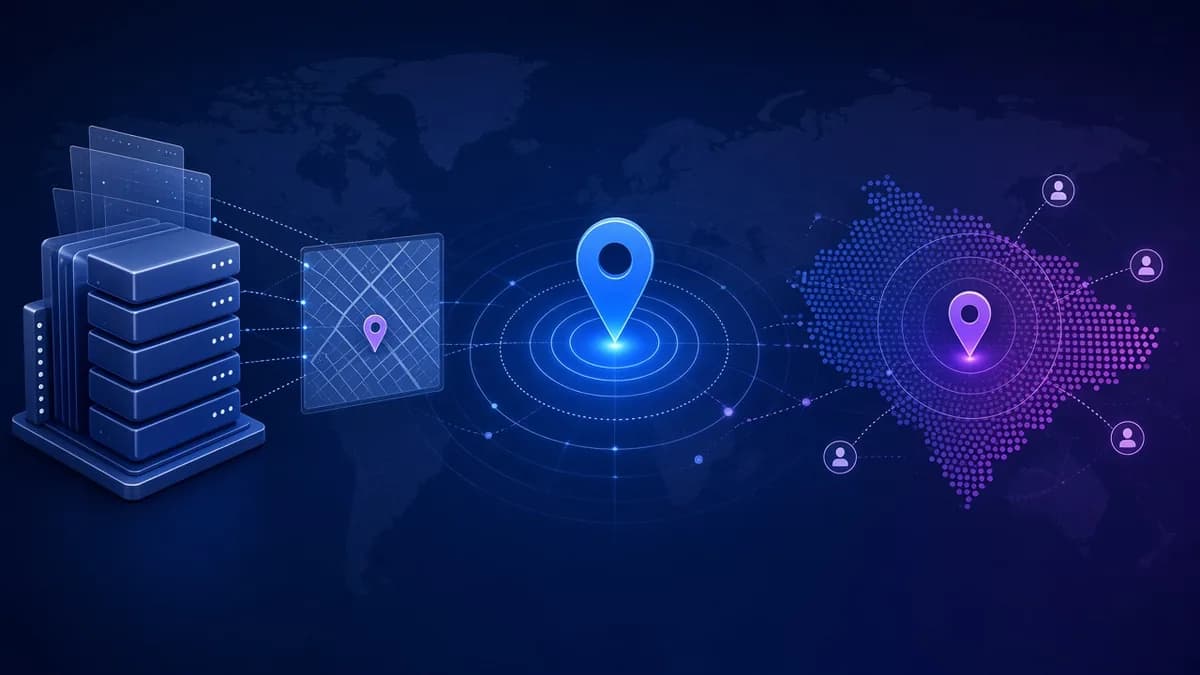
Geographic targeting decides whether your leads come from people you can serve — or from cities, ZIP codes and regions that never convert. For local businesses and multi-location brands, that difference is commercial, not cosmetic.
When marketers compare **LeadsPlease vs Google Ads**, they often ask which option offers better geographic targeting accuracy. LeadsPlease is a consumer and business data / mailing-list provider. Google Ads and Facebook Ads (Meta Ads) are advertising platforms that estimate who is in — or interested in — a place, then deliver ads in real time.
Those are different tools. Database-based geographic selection picks records tied to addresses, ZIP codes, cities, carrier routes or drawn map areas. Advertising-platform location targeting uses device, IP, profile and behavioural signals to decide whether someone should see an ad. Neither approach is 100% accurate in every case. Geographic precision is also not the same as lead quality.
Author: Sai Charan Teja Rayudu, Founder & CEO at WebNextra. Last updated: 24 November 2026.
01
Understanding Geographic Targeting in Lead Generation
Geographic targeting limits marketing reach to people associated with specific places — countries, states, cities, ZIP codes, service radii or custom map areas.
Location-based audience selection
Location-based audience selection can mean buying contact records that match a geography (targeted mailing lists), showing ads to people estimated to be in or near selected places (location-based advertising), or qualifying inbound leads by service area after they enquire.
Local and hyperlocal lead generation
Local business lead generation usually needs more than a city name. Hyperlocal lead generation may focus on neighbourhoods, ZIP clusters, a radius around a store or a polygon that matches a real service boundary. The tighter the geography, the more important it is to understand *how* each platform defines "in this area".
Reaching people vs purchasing contact databases
Advertising platforms help you reach people who may be in a place now, recently, or interested in it — often without handing you their mailing address up front. Data providers help you select contact records already tied to a geography for mail, call or email under applicable consent rules. One method optimises for media delivery; the other optimises for addressable contact selection.
02
What Is LeadsPlease and How Does Its Geographic Targeting Work?
LeadsPlease sells consumer and business mailing lists and related contact data. According to the company, buyers can filter geography and demographics or firmographics, preview counts and prices, then download lists for direct mail and other outbound uses.
Consumer and business databases
LeadsPlease positions itself around large U.S. consumer and business databases. That makes it relevant for marketers who need targeted mailing lists in U.S. geographies. It is not a real-time advertising auction like Google Ads or Meta Ads.
ZIP code, city, county, street and carrier route targeting
On LeadsPlease's geography selection flow, buyers can specify geography manually — including states, counties, cities, ZIPs, streets or carrier routes. That postal and street selection is closer to mailing-list construction than to typical paid-social radius rings.
Radius and polygon-based geographic selection
The same tools also allow radius selection around an address and polygon drawing on a map. For hyperlocal lead generation, polygon and carrier-route selection can match irregular service areas better than a simple city target.
Mailing list applications and data limitations
Typical use cases include direct mail, local prospecting and outbound contact sets for defined catchments. Contact information availability is part of the product model — subject to list type, licensing and marketing laws.
LeadsPlease publishes deliverability expectations on its data quality pages, including USPS-related address hygiene and stated deliverability ranges when lists are used within a defined window. Treat those figures as provider claims, not independent benchmarks. Even well-maintained databases change as people move, businesses close and consent status shifts.
03
How Does Google Ads Geographic Targeting Work?
Google Ads location targeting lets advertisers show ads to people in, regularly in, or who have shown interest in selected places. Official Google Ads Help covers country, region, city, proximity and advanced presence settings.
Country, state, city, regional and radius targeting
Campaigns can use supported location criteria such as countries, states/regions, cities and other available geographic units. Google Ads API location targeting also supports proximity (radius) targeting around an address or point — widely used for stores, clinics and local catchments. Postal or ZIP-style targets are available where Google's geo target set includes them.
Presence vs Presence or Interest
Google distinguishes physical location (where someone is or regularly is) from locations of interest (places suggested by search terms, maps behaviour, content context and related signals). Advanced location options can focus more tightly on presence or include interest. The default often covers both, which can widen reach beyond people physically inside the target area.
Location signals, exclusions and limitations
Google uses multiple signals — including IP address and, where available, device location from GPS, Wi-Fi, Bluetooth or cell-based estimates — to estimate location. Advertisers can exclude locations. Google states that location targeting is a best-effort system and that 100% accuracy is not guaranteed in every situation.
For lead generation, Google Ads often pairs geography with search intent. Location accuracy and keyword intent are separate levers. See Google Ads management and Google Ads lead generation.
04
How Does Facebook and Instagram Ads Geographic Targeting Work?
Facebook Ads geographic targeting (Meta Ads for Facebook and Instagram) lets advertisers include and exclude places such as countries, regions, cities, ZIP codes, places and custom latitude/longitude locations with radius controls.
City, region, ZIP and radius controls
Meta's basic targeting documentation describes city and regional targets, ZIP targeting where available, city radius options and custom locations with configurable radius ranges. These controls support geographic audience targeting and hyperlocal lead generation around a store or job site.
People living in or recently in selected locations
Current Meta location-type options commonly emphasise people whose home location is in the area and people recently in the area (often inferred from mobile device data). Advertisers should verify the live Ads Manager options for their account and objective, because Meta targeting controls change over time and special ad categories can restrict settings.
Location expansion and Meta limitations
Audience expansion or Advantage-style delivery can increase volume while reducing geographic tightness.
Limitations include estimated location from profile, IP and device signals; "recent" presence that can include travellers; and lead quality that still depends on creative, offer, landing page and follow-up. See social media marketing and Google Ads vs Meta Ads for lead generation.
05
LeadsPlease vs Google Ads vs Facebook Ads: Detailed Comparison
Features vary by country and campaign type. LeadsPlease is strongest as a U.S.-oriented mailing-list product; Google Ads and Meta Ads are global advertising platforms.
| Comparison point | LeadsPlease | Google Ads | Facebook / Instagram Ads (Meta) |
|---|---|---|---|
| Type of service | Consumer/business data and mailing lists | Search, display and related paid advertising | Social and related paid advertising |
| Geographic selection method | Database filters: state, county, city, ZIP, street, carrier route, radius, polygon | Geo targets and proximity; presence / interest options | Geo locations, exclusions, city/ZIP/custom radius; home/recent location types |
| City-level targeting | Yes (manual geography) | Yes, where supported | Yes, where supported |
| ZIP code targeting | Yes | Often available where Google supports postal geo targets | Yes, where supported |
| Radius targeting | Yes (around an address) | Yes (proximity targeting) | Yes (city radius / custom locations within Meta ranges) |
| Address-level geographic selection | Stronger for list building (street / carrier route / address-tied records) | Not the same as buying address lists; proximity around an address for ads | Custom locations around an address for ads; not a mailing-list export |
| Audience intent | Not an ads auction; outreach depends on your offer and channel | Often high when paired with search queries | Usually interruptive / discovery; creative creates interest |
| Contact information availability | Core product (list fields by product type) | Typically captured after click via forms, calls or assets | Typically captured via forms, messages or site conversions |
| Real-time advertising capability | No — list purchase / outbound use | Yes | Yes |
| Data freshness | Depends on provider update cycles and your use window; provider publishes hygiene claims | Location estimated at ad-serve time from live signals | Location estimated at ad-serve time from live signals |
| Best use cases | Direct mail and outbound to defined U.S. geographies | High-intent local search demand and measurable paid response | Local awareness, visual offers, retargeting, social lead forms |
| Geographic limitations | Coverage is list/database-led (notably U.S. mailing markets); records can go stale | Signal-based; interest targeting can broaden beyond physical presence; not 100% accurate | Signal-based; recent visitors and expansion settings can broaden geography |
Digital advertising vs mailing lists is not a pure accuracy contest — it is a choice between addressable records and media against estimated locations.
06
Which Platform Offers Better Geographic Targeting Accuracy?
There is no universal winner for geographic targeting accuracy.
When LeadsPlease is suitable
Choose LeadsPlease-style database selection when you need addressable contacts inside precise postal geographies — especially for direct mail or outbound built on ZIP, street, carrier route, radius or polygon selection. Accuracy here means how well records match the selected geography and remain deliverable.
When Google Ads is suitable
Choose Google Ads when people are actively searching for what you sell. Presence-focused settings, exclusions and radius targets help local providers reduce waste. Geographic accuracy still depends on Google's location signals and your advanced location options.
When Meta Ads is suitable
Choose Facebook and Instagram ads when visual storytelling, local awareness or social lead capture matters inside a city, ZIP set or radius. Home and recent controls can tighten geographic audience targeting; expansion settings can loosen it.
Geographic precision vs lead quality
A perfectly drawn map can still produce weak leads if the offer, landing page, form or follow-up is weak. See digital marketing lead generation and lead generation services in Hyderabad.
07
How to Improve Geographic Targeting Accuracy for Lead Generation
These practices usually improve location targeting for lead generation:
1. Choose relevant service locations — target only areas you can serve profitably. 2. Exclude irrelevant areas — remove cities, ZIPs or radii that historically waste spend. 3. Review geographic performance reports — compare conversions by location, not only clicks. 4. Use location-specific landing pages — match the page to the city or service area in the ad. 5. Add location qualification questions to lead forms — ask for city, PIN/ZIP or service area early. 6. Verify lead contact details with consent — confirm reachable numbers and emails under applicable rules. 7. Measure qualified leads rather than just form submissions — track sales-accepted leads and closed revenue.
WebNextra helps businesses apply these controls across digital marketing services, paid search and paid social.
08
Which Geographic Targeting Method Should Your Business Choose?
Real estate companies
Project launches often combine Meta/Google radius or city targeting with, where relevant, mailing lists for defined ZIP clusters. See real estate lead generation in Hyderabad.
Local service providers
Plumbers, clinics, tutors and home services usually start with Google Ads presence and radius targeting, then use Meta for local awareness. List data can supplement outbound where compliant.
Retail businesses
Retail often needs radius targeting around stores and exclusions for areas too far to visit. Social creative and search both play roles.
B2B companies
B2B may need city or region targeting plus firmographic filters. Lists can support outbound; Google and other intent channels often support inbound. Geography alone rarely defines a qualified B2B lead.
Multi-location businesses
Multi-location brands usually need separate location structures, location-specific landing pages and reporting by outlet. Shared citywide campaigns often blur which branch a lead belongs to.
Looking to generate better-quality leads through location-based advertising? Explore WebNextra's digital marketing solutions.
FAQ
Frequently Asked Questions
Is LeadsPlease more accurate than Google Ads?
Not universally. LeadsPlease can be more precise for selecting address-tied records inside ZIP, street, carrier route or polygon geographies. Google Ads estimates whether someone should see an ad based on location signals. "More accurate" depends on whether you need a mailing list or real-time ads.
Can Google Ads target specific ZIP codes?
In many markets Google Ads supports postal-code or equivalent geo targets where those locations exist in Google's geo target set. Availability varies by country. Radius targeting can approximate catchments when postal targets are limited.
Does Facebook Ads offer location-based targeting?
Yes. Facebook and Instagram ads support countries, regions, cities, ZIP codes and custom radius locations, with location-type controls such as home and recent. Confirm the options in Ads Manager for your campaign type.
What is the difference between radius targeting and ZIP code targeting?
ZIP code targeting follows postal boundaries. Radius targeting draws a circle around a point. ZIP codes can match mailing routes more cleanly; radius targeting can better fit a store's drive-time area that crosses several ZIPs.
Which platform is better for local lead generation?
It depends on intent and workflow. Google Ads is often stronger when people are searching now. Meta Ads is often stronger for visual discovery and remarketing. LeadsPlease-style lists fit outbound and direct mail. Many local businesses combine channels.
Does accurate geographic targeting guarantee quality leads?
No. Accurate geography reduces irrelevant locations, but lead quality also depends on offer, messaging, landing experience, qualification, consent-compliant contact capture and sales follow-up.
10
Final Verdict
**LeadsPlease vs Google Ads vs Facebook Ads** is less a contest for a single accuracy score and more a match between method and job.
- Use LeadsPlease when you need targeted mailing lists and database-based geographic selection down to ZIP, street, carrier route, radius or polygon geographies.
- Use Google Ads when search intent plus Google Ads location targeting can bring in-market local demand.
- Use Facebook Ads geographic targeting when social discovery, creative and local audience reach should open the top of the funnel.
Define the real service map first, then pick the channel that matches how customers decide — search, social or outbound — and measure qualified leads, not map aesthetics alone.
WebNextra helps businesses plan and optimise Google Ads, Meta Ads and lead generation with clearer location controls and qualification. For location-based lead generation that prioritises relevance over volume, start on our digital marketing services page.